Inclusion vs. Other Approaches to Special Education
Inclusive education seeks to improve the educational outcomes for all students by valuing their unique contributions and abilities. It includes ‘diverse human identities’ without judging or assigning value to these identities (Jones & Danforth, 2015, p.16). As such, it differs from models of segregation, where children with disabilities were pathologised, undereducated, and treated as ‘others’ (Carrington, 1999). It is also different to integration, which attempted to make up for the drawbacks of integration by hurling students with special needs into mainstream classrooms with inadequate support (Booth & Ainscow, 1996).

Walton (2016) defines inclusive education as a system of education that is working towards greater educational success for all students through (macro) system-wide restructuring and (micro) classroom support, and which is also underpinned by inclusive values at both government and community level. Essentially, inclusive education is about restructuring education systems so that schools and classrooms fit populations of diverse learners, rather than forcing these learners to fit the existing, restrictive, mold. It requires transformation, rather than just change (Walton, 2016, p.55). The idea is that, rather than trying to fit ‘square pegs into round holes’ (as it were), we remove the pegs and holes (in this case, barriers to education) altogether and create a system where students are given the support they need to succeed.
What is Inclusion?: Equity vs. Equality
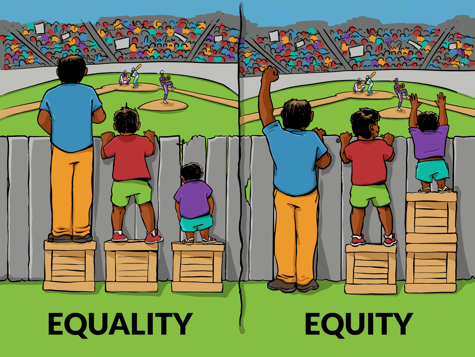
The image to the right is often used to demonstrate the ‘spirit’ of inclusive education. Equality offers everyone the same opportunity, while equity offers individuals the level of support needed by them to access the same opportunities and experiences as others. Although this image points out a ‘truth’ that seems obviously fair and ethical, I would argue that it does not accurately capture the true spirit of inclusive education.
Education needs to consider the needs of all students (Curcic, 2009) – not just those who require additional support to access the core curriculum. Indeed, inclusive schools should not focus solely on improving access for students with learning support needs (Carrington, 1999, p.259), but also need to ensure that those who have the ability to achieve higher results (such as gifted and talented students) are equally supported to reach their own potential. As one principal questioned in Shapiro and Stefkovich’s study of ethical leadership “Are we still managing to continue to add value to the kids who are doing well…?” (in Ehrich & Carrington, 2017, p. 77). Inclusive education, in order for it to truly be ‘inclusive’, needs to do much more than focus on the needs of one or a few groups of students.

I contend that this second image better captures the goals of inclusive education. The wooden fence represents institutionalised bias – a ‘one-size fits all’ system. Rather than only making adjustments at the micro-level for each individual student, inclusive education must be about recognising and removing barriers (turning the wooden fence into one that can easily be seen through) that obstruct educational success for all students in our diverse population. Walton (2016, p.55) argues that inclusive education ‘requires a fundamental change to the way we do things’. From this perspective, we need to adapt our systems to ensure that we remove institutionalised bias that for decades has segregated some groups (e.g. students who have special needs) and positioned them as less capable or worthwhile than others.
Student Outcomes: The Evidence for Inclusive Education
Perhaps the case for inclusive education is best summed up by Rawls, who argues that unequal treatment is justified only if the weakest members of society benefit (in Szumski, Smogorzewska & Karwowski, 2017, p.35). Unequal treatment for students with special needs (albeit often with the best intentions) has been the hallmark of special education programs for decades. It is clear that models of segregation and integration have failed these students. By contrast, inclusive education emphasises the importance of equal treatment for students in growing their social capital and fostering well-being, whilst ensuring that ‘unequal treatment’ (such as differentiation) is administered in a beneficial way.
Evidence suggests inclusive education provides clear positives for student outcomes. For one thing, disabled students in inclusive education settings outperform those in segregated environments, as seen in the image below (Hehir, Grindal, Freeman, Lamoreau, Borquaye & Bourke, 2016).
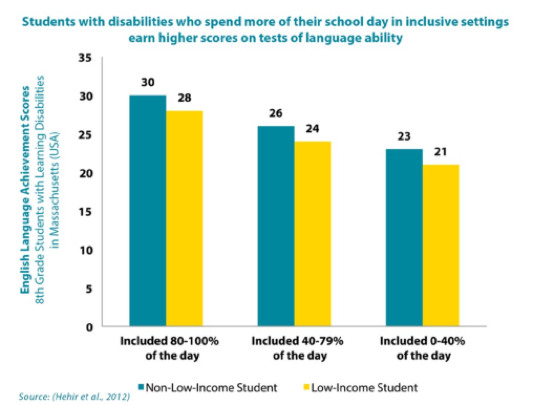
Research also shows us that inclusive education helps students achieve better academically. Evidence from studies in American schools show that, even when controlled for other factors, students who were included in with their non-disabled peers during the school day achieved better, and these outcomes rose in line with increases in amount of time spent in such settings (Hehir, et. Al. 2016, p.13). Furthermore, cooperative learning between students of differing abilities has been widely shown to be associated with better outcomes (Mitchell, 2013, p. 40). Clearly, students of diverse abilities benefit from learning amongst their peers in supportive environments.
‘On the Ground’: Supporting Teacher’s Efficacy
Structural change does not necessarily come easily for schooling systems or educators. School systems, curriculum and teacher skill must come together and work as one in order for inclusive education to be successful (Lancaster, 2004, p. 228). In addition, positive attitudes and beliefs around inclusion are integral for actually creating effective inclusive practices in the classroom (Savage & Erten, 2015). However, research shows that a majority of teachers have views of inclusive education which are neutral at best and often negative (de Boer, Pijil, & Minnaert, 2011).

All of this evidence points to the fact that for inclusive education to be successful, teachers need to ‘buy-in’ and be supported by appropriate professional development opportunities. After all, Hattie’s (Donohoo, Hattie & Eells, 2018) research into factors related to student achievement shows us that ‘combined teacher efficacy’ is the most important factor for student success (see image to right).
However, school leaders and communities will need to be sensitive to the changes in beliefs and values that may be required by some (Carrington, 1999, p.261). Skills-building and improving teachers’ inclusive practices need to be done in a way that values teachers’ existing bodies of professional knowledge, experiences and capabilities.
While this poses a significant challenge for educators, the research is clear. When done well, inclusive education removes barriers and provides genuine results for all students – those with special learning needs and those without. With critical and thoughtful practice, schools have a genuine opportunity to provide equity of opportunities and outcomes for students.
References
Booth, Tony, & Ainscow, Mel. (2002). An Inclusive Approach to School Development. In T., Booth & M., Ainscow (Eds.) Index for inclusion: developing learning and participation in schools (pp. 1–11). Bristol, UK: CSIE. Retrieved from: https://content.talisaspire.com/qut/bundles/5761407ae7ebb6816300001a
Carrington, S. (1999). Inclusion needs a different school culture. International Journal of Inclusive Education, 3(3), 257–268. Retrieved from: https://doi-org.ezp01.library.qut.edu.au/10.1080/136031199285039
Curcic, S. 2009. Inclusion in PK-12: An international perspective. International Journal of Inclusive Education 13, no. 5: 517–38. Retrieved from: https://doi-org.ezp01.library.qut.edu.au/10.1080/13603110801899585
de Boer, A. Pijl. S. J., & Minnaert, A. , “Regular primary schoolteachers’ attitudes towards inclusive education: A review of the literature.,” International Journal of Inclusive Education, 15(3), 331-353. Retrieved from: http://www-tandfonline-com.ezproxy.lib.utexas.edu/doi/pdf/10.1080/13603110903030089?needAccess=true
Donohoo, J., Hattie, J., & Eells, R. (2018). The Power of Collective Efficacy. Educational Leadership, 75(6), 40–44. Retrieved from: https://web-a-ebscohost-com.ezp01.library.qut.edu.au/ehost/detail/detail?vid=0&sid=2fdb2042-3a36-414c-ae51-ef46510f6c94%40sessionmgr4007&bdata=JkF1dGhUeXBlPWlwLHNzbyZzaXRlPWVob3N0LWxpdmUmc2NvcGU9c2l0ZQ%3d%3d#AN=128251803&db=afh
Ehrich, L. C. & Carrington, S. (2017). Chapter 8: Making sense of ethical leadership. In In J., Harris, S., Carrington, & M., Ainscow (Eds.) Promoting Equity in Schools: Collaboration, inquiry and ethical leadership (pp. 121–141). Oxford, UK: Routledge. Retrieved from https://gateway.library.qut.edu.au/login?url=https://search.ebscohost.com/login.aspx?direct=true&AuthType=ip,sso&db=nlebk&AN=1592774&site=ehost-live&scope=site&ebv=EK&ppid=Page-__-73
Hehir, T., Grindal, T., Freeman, B., Lamoreau, R., Borquaye, Y., & Burke, S. (2016). A summary of the evidence on inclusion education. Cambridge, MA: ALANA & Abt Associates. Retrieved from http://alana.org.br/wp-content/uploads/2016/12/A_Summary_of_the_evidence_on_inclusive_education.pdf
Jones, P., & Danforth, S. (2015). From special education to integration to genuine inclusion. In P. Jones & S. Danforth (Eds.), Foundations of inclusive education research (First edition, Vol. 6) (pp. 1-22). Bingley, UK: Emerald. Retrieved from https://ebookcentral.proquest.com/lib/qut/reader.action?ppg=12&docID=4339897&tm=1547438001562
Lancaster, J. (2014). School and Classroom Indicators of Inclusive Education. In C. Forlin & T. Loreman (Eds.) Measuring Inclusive Education (pp.227-246). Bingley, UK: Emerald Publishing Limited. Retrieved from https://ebookcentral.proquest.com/lib/qut/detail.action?docID=1840437.
Mitchell, D. (2014). What really works in special and inclusive education : using evidence-based teaching strategies (Second edition). London; UK. Routledge. Retrieved from: https://ebookcentral.proquest.com/lib/qut/detail.action?docID=1596944
Savage, R. S., & Erten, O. (2015). Teaching in inclusive classrooms: The link between teachers’ attitudes-practices and student outcomes. Journal of Psychology & Psychotherapy, 5(6), 219. Retrieved from: https://www.omicsonline.org/open-access/teaching-in-inclusive-classrooms-the-link-between-teachers-attitudespractices-and-student-outcomes-2161-0487-1000219.php?aid=65875
Szumski, G., Smogorzewska, J., & Karwowski, M. (2017). Academic achievement of students without special educational needs in inclusive classrooms: A meta-analysis. Educational Research Review, 21, 33–54. Retrieved from: https://doi-org.ezp01.library.qut.edu.au/10.1016/j.edurev.2017.02.004
Walton, E. (2016). Chapter 3: The meaning of inclusive education. In The language of inclusive education: exploring speaking, listening, reading and writing (pp. 47–65). London: Routledge. Retrieved from https://www.taylorfrancis.com/books/9781317638681/chapters/10.4324%2F9781315759272-11
Image References
Image 1:
Eredics, N. (2018). Why Would We Separate, Segregate & Alienate Children From One Another While at the Same Time Teaching Them to Look After the World Around Them, Respect Differences & Take a Stand on Injustice? [Image]. Retrieved from: https://ollibean.com/why-would-we-want-inclusive-education-2/
Image 2:
Maguire, A. (2016). Equality vs. Equity. [Image]. Retrieved from: http://interactioninstitute.org/illustrating-equality-vs-equity/
Image 3:
City for All Women Initiative (CAWI). (2015). Equality Versus Equity. [Image]. Retrieved from: http://www.cawi-ivtf.org/sites/default/files/publications/advancing-equity-inclusion-web_0.pdf
Image 4:
Hehir, T., Grindal, T.,
Freeman, B., Lamoreau, R., Borquaye, Y., & Burke, S. (2016). A summary of the evidence on inclusion
education. Cambridge, MA: ALANA & Abt Associates. Retrieved from http://alana.org.br/wp-content/uploads/2016/12/A_Summary_of_the_evidence_on_inclusive_education.pdf
Image 5:
Donohoo, J., Hattie, J., & Eells, R. (2018). The Power of Collective Efficacy. Educational Leadership, 75(6), 40–44. Retrieved from: https://web-a-ebscohost-com.ezp01.library.qut.edu.au/ehost/detail/detail?vid=0&sid=2fdb2042-3a36-414c-ae51-ef46510f6c94%40sessionmgr4007&bdata=JkF1dGhUeXBlPWlwLHNzbyZzaXRlPWVob3N0LWxpdmUmc2NvcGU9c2l0ZQ%3d%3d#AN=128251803&db=afh

 Teacher.Learner